Sunday, June 17, 2018
The rise and fall of average IQ test scores
I was just cranking up my aged brain to say something about the latest IQ findings when I found that young Oliver Moody of "The Times" has spared me the trouble. His summary is below. There are a few things I would like to add, however.
Perhaps the most interesting fact to emerge is that dumb women having more babies is not a problem. As long as I have been reading the literature on IQ, people have been worried about that. Are all these smart ladies who think no man is good enough for them degrading the average intelligence of the human race? Wonder of wonders, the latest research from Norway was able to rule that out.
Various people have pointed out that the dumbest females for various reasons tend to have NO babies and a majority of high IQ females do have some babies. And it was always hoped that those two effects would cancel one another out. And we now have grounds to believe that exactly that has happened.
A lot of interesting IQ research comes out of Norway and Sweden. The reason is that the Scandinavian countries are very authoritarian, which leads them to keep extensive records about each individual person in their countries. So if you can get access to government data you can base your research on the whole population, not just a sample, with all its attendant doubts and difficulties.
So what we now know with some confidence is that IQ scores rose during the first three quarters of the 20th century but then flattened out before going into a decline. And that could clearly not be due to genetic changes. Evolution doesn't work that fast.
So what WAS going on? There are two major possible explanations: Computer games and education. Blaming computer games has been going on as long as there have been computer games and it is in my mind just snobbery or some such: A convenient whipping boy for all sorts of ills. There is actually a fair bit of evidence that games and internet exposure generally are most likely to be good rather than bad for our brains (e.g. HERE and HERE and HERE)
Additionally, like Piaget, I have tended to find the kids in my care to be instructive. My son, for instance, could load up and play his favourite computer game when he was two and he plays a lot of games to this day now he is in his 30s and works as an IT professional. And what I saw was that game playing is normally quite social. There will usually be other kids hanging around and talking even with single-user games and some games are quite educational in themselves. My son learnt most of his ancient history from "sims" set in that era. He learnt precious little ancient history at school. So I personally exonerate games from being bad for most people.
So what DID go wrong? Just one thing can account for both the rise and fall in measured IQs: Testing.
During my schooldays in the '50s testing was all the rage. We even did IQ tests at least once a year. And there were heaps of in-school tests. From about grade 3 on, for instance, we would have weekly spelling tests -- in which a kid got a list of 10 words that he had to learn how to spell. Being a born academic, I always got 10 out of 10 and was regularly praised for it. Which was a bit unfair because I put zero work into it. I just had to see a word once to know how to spell it. I still do.
And I think that is one example of a huge difference between then and now. Education used to be COMPETITIVE and "winners" got all the praise. And nobody apologized for that.
It seems to me that there should be no great difficulty in arranging prizes for both ability and effort but the Left have simply closed their eyes to ability
By about 1975 or thereabouts, however, the political Left had got a vice-like grip on education worldwide. Even in chapter 48 of my 1974 book, I noted its encroachment. And Leftists HATE competition because it clashes with their idiotic and counterfactual belief that "All men are equal". To validate that gospel, therefore, all had to have prizes, not just one kid. And if you believe that all men are equal, there would be no point in testing. If the marks come out all the same, what would be the point? But the marks don't come out all the same so to avoid that reality, you just don't do testing if you can avoid it.
The rise in measured IQ scores during the first three quarters of c20 has been the cause of much discussion and the most usual explanation for it is that it was due to the steady expansion of education during that era. More kids gradually got more education as the century wore on. And that was highly relevant to performance on IQ tests. All the testing you did at school made you "test-wise" and that helped you to do well on IQ tests.
You learnt, for instance that ever useful strategy of: "If you don't know, guess". Some guesses will be right and that will raise your overall score. IQ subtests that were not facilitated by testing -- breadth of vocabulary for instance -- showed very little rise in scores. You know what an uncommon word means or you don't. So it was environmental rather than genetic factors that explains the rise in average IQ scores -- known generally as the "Flynn" effect.
But the dominance of Leftism wiped all that. Leftists have a horror of competition so avoided testing at all costs. So an education no longer helped you to do well on IQ tests. And as Leftism gradually tightened its grip, the education effect on IQ scores shrank and shrank. So IQ scores declined gradually over the years.
It's consoling to note however, that the genetic contribution to IQ test score has not changed. We are still as bright as we ever were and what we are genetically is increasingly the sole thing reflected in the IQ test scores.
The IQ scores of young people have begun to fall after rising steadily since the Second World War, according to the first authoritative study of the phenomenon.
The decline, which is equivalent to at least seven points per generation, is thought to have started with the cohort born in 1975, who reached adulthood in the early Nineties.
Scientists say that the deterioration could be down to changes in the way maths and languages are taught, or to a shift from reading books to spending time on television and computers.
Yet it is also possible that the nature of intelligence is changing in the digital age and cannot be captured with traditional IQ tests. The turning point marks the end of a well-known but poorly understood trend known as the Flynn effect, in which average IQs have risen by about three points a decade for the past 60 or 70 years.
“This is the most convincing evidence yet of a reversal of the Flynn effect,” Stuart Ritchie, a psychologist at the University of Edinburgh who was not involved in the research, said. “If you assume their model is correct, the results are impressive, and pretty worrying.”
There had been signs that IQ scores might have fallen since the turn of the millennium. Two British studies suggested that the decline was between 2.5 and 4.3 points per decade. This has not been widely accepted owing to the limited research to date. A study has now shown, however, that Norwegian men’s IQs are measurably lower today than the scores of their fathers at the same age.
Ole Rogeberg and Bernt Bratsberg, of the Ragnar Frisch Centre for Economic Research in Oslo, analysed the scores from a standardised IQ test of more than 730,000 men who reported for national service between 1970 and 2009. The research appears in the journal PNAS.
The vast majority of young Norwegian men are required to perform national service and take a standardised IQ test when they join up.
The results, published in the journal PNAS, show that those born in 1991 scored about five points lower than those born in 1975, and three points lower than those born in 1962.
The reasons behind the Flynn effect and its apparent reversal are disputed. Scientists have put the rise in IQ down to better teaching, nutrition, healthcare and even artificial lighting.
Some academics suggest the recent fall could be down to genetics. Their argument is, crudely, that less intelligent people have more babies, and so over time the gains are cancelled out by the spread of genes linked to low-intelligence.
Yet this theory has been scotched by the Norwegian paper. Because the decline can be observed within the same families, it is unlikely to be the result of a demographic shift.
Dr Rogeberg said it was more plausible that the changes in the way children are educated or brought up – such as less time drilling pupils in reading and mathematics – were at play.
He stressed that the findings did not necessarily mean that today’s young people were any more stupid than their parents. Instead, it may be that definitions of intelligence have yet to catch up with the skillset needed to navigate the digital era.
“Intelligence researchers make a distinction between fluid and crystallised intelligence,” he said. “Crystallised intelligence is stuff you have been taught and trained in, and fluid intelligence is your ability to see new patterns and use logic to solve novel problems.”
Classic IQ tests, with their emphasis on arithmetic and verbal reasoning, tend to favour the kind of crystallised intelligence that is fostered by a more traditional education. “If this is the underlying cause of the decline, this need not be overly worrying,” Dr Rogeberg said.
Robin Morris, professor of neuropsychology at King’s College London, said IQ scores probably had hit a ceiling in the west, but there was not yet any reason to be unduly concerned.
“I think the reverse Flynn effect is real but would urge caution about generalising based on one sample,” he said. “Probably the tailing off is a general effect in high income countries in which the contributor factors generally stabilise.”
SOURCE

Friday, June 1, 2018
Genetic Intelligence Tests Are Next to Worthless (?)
I take the title above from the title of a long and very readable article by Carl Zimmer, a NYT journalist. You could almost predict the title from the fact that he is a NYT journalist.
But the article is extremely well done. It is something of a triumph of the journalist's art. He explains the facts and issues of his subject beautifully. I wish I could write as well. We both try for lucidity and simplicity but he does by far the better job. That he is a journalist and that I am an academic shows. I never could get teddy bears into my writing.
The article is a long one so I am not even going to excerpt it. Instead I am going to offer what I hope is a fuller perspective on the matters he raises. Put simply, he mistakes the major issue involved.
When we look at his title, we have to ask: "Worthless for What? His answer is that currently available genetic information is useless as a substitute for a normal IQ test. He is absolutely right about that and his warning is well-taken. People who claim to assess your IQ from your genetic profile are little better than quacks and their results are of no everyday use.
And the reason for that is that IQ appears to be just one aspect of your body's general good functioning. The brain is just one organ of the body and if the body overall is functioning well the brain should be working pretty well too. And from the research with IQ tests we find an amazing range of good things that high IQ correlates with -- better health, longer life more harmonious marriages etc. You name it, more or less.
So that lies behind the fact that there are a LOT of influences on your IQ. They may be scattered anywhere in your body. What IQ researchers have said for a long time is that IQ is "polygenetic". It is the sum of a whole lot of little genetic influences. Almost anything that influences your overall health could also influences your IQ.
At this stage I have to stress that I am talking about the "in general" case. As elsewhere in life, there are exceptions to the general rule. There are healthy specimens who are as dumb as a brick (some Hollywood actors?) and there are other unfortunates such as Stephen Hawking and Carl Steinmetz where a brilliant brain inhabits a broken body. Sometimes you need just one faulty gene to have a big influence on your bodily health.
And it is the general case that interests scientists. They are not actually much interested in YOU. They are only interested in what emerges from a study of people in general. So when they find some of the many influences on IQ in people's genes they see themselves as being on the right track in seeing IQ as mainly genetic. And the advances are already exciting. As each new study comes out, more and more of the genetic influences on IQ are being found. Genetics generally is in its infancy and the genetics of IQ are no exception.
And so far there has not been a single study looking at epigenetic influences on IQ. Epigenetics are bits of your genetic profile which influence how other genes work. They can even turn a gene "on" or "off". So to expect that current studies could give us the whole genetics of IQ is very naive. The fact that we have at this early stage already been able to detect some of the genetics involved is the interesting and exciting part.
In other words the issue is not whether or not we can measure your IQ from your genes right now but rather whether we are on the right track towards that. And from a scientific point of view we are doing amazingly well considering the huge difficulty of such research -- JR.
Monday, May 21, 2018
MIT professor Eric Lander apologizes for praising controversial Nobel winner James Watson
Watson's statements on IQ were well-grounded in psychometrics
Eric Lander, the founding director of the Broad Institute of MIT and Harvard, has apologized for toasting 90-year-old Nobel Prize winner James Watson over the weekend.
In a contrite e-mail to colleagues, first reported Monday by Stat, Lander said he was aware of Watson’s racist and misogynist views, and had even been present when the celebrated scientist made anti-Semitic statements, but ultimately agreed to praise Watson for his role in the Human Genome Project.
In his tribute to Watson at a Biology of Genomes meeting at Cold Spring Harbor Laboratory Saturday, Lander credited Watson for "inspiring all of us to push the frontiers of science to benefit humankind." He neglected to mention that the man who helped discover the double helix also has suggested there’s a link between exposure to sunlight and sexual urges, and argued that there is racial disparity in intelligence based in biology.
In his e-mail Monday, Lander said he should not have toasted Watson. Though he did make an oblique reference to Watson’s past statements when he called him "flawed," that wasn’t enough, Lander said.
"I’d like to do that now: I reject his views as despicable," Lander wrote, according to Stat. "They have no place in science, which must welcome everyone. In retrospect, I should have followed my first instinct, which was to decline the invitation. As someone who has been on the receiving end of his abhorrent remarks, I should have been sensitive to the damage caused by recognizing him in any way."
Before the apology, social media reacted angrily to Lander’s remarks.
"By toasting Jim Watson, Eric Lander is saying that sexism, racism, anti-semitism, and all sorts of forms of harassment and vile behavior by someone in power in science is A-OK — disgusting," tweeted University of California-Davis professor Jonathan Eisen, who also posted a video of Lander’s tribute, calling it "a horrific action."
"I hope we can all pause and think deeply about which scientists we choose to honor & why," tweeted Michael Eisen, a biologist at UC Berkeley. "How it is that someone everyone knows to be racist, sexist & anti-semitic is still among us, let alone toasted. And how many lives and careers have been & are being ruined by our silence?"
SOURCE
Monday, May 7, 2018
Stop Talking About Race and IQ
Does WILLIAM SALETAN deny the humanity of blacks?
My heading above is copied from a recent, very long-winded article by Saletan, who is a sort of token conservative among prominent journalists. Saletan accepts that there are large differences between black and white IQ averages but thinks we should not talk about it. To help us think about the matter, let us look at some hypothetical statements about dogs:
Long tails in dogs are hereditary
Great Danes have long tails
Therefore long tails in Great Danes are hereditary
That conclusion seems pretty reasonable, does it not? From my memory of my studies in formal logic of over 50 years ago, I think it is in fact a valid syllogism.
Here is another very similar syllogism that refers to the centrepiece of the Saletan article.
Low IQs are hereditary
Blacks have low IQs
Therefore low IQs in blacks are hereditary.
Is that syllogism not as valid as the first?
Saletan wants to say that that conclusion is NOT logical or is at least unproven. The only way he can do that, however, is to attack one or both of the premises. He attacks the statement that low IQs are hereditary. He says that statement is overly broad. It may be that among blacks IQ is not hereditary or is hereditary in some different way.
But there have now been many studies of brain function (GWAS studies) which show that IQ involves a large number of brain components and the most recent studies have in fact shown that neuron size is heavily involved in IQ. Smart people have bigger neurons. And note that the brain is almost entirely composed of neurons.
So Saletan is saying that all those GWAS features are different in blacks. He is denying the humanity of blacks. He is in effect saying that blacks are a different species, almost something extra-terrestrial. I am betting that he does NOT want to say that but his argument leads to it. He would not want to say that because he places great stress on kindness to blacks as being a big issue in the debate. Telling blacks that they are on average dumber and can't change that is unkind.
I don't think it is unkind. It is lies that are unkind. As Eysenck often said, the policies you derive from low average black IQs could as well be kind as anything else. By having lower expectations of blacks, you could be relieving stresses on them to keep up in various ways, for instance.
And we do in any case ordinarily make it very clear to all blacks that they are on average dumber. That is the famous educational "gap". In their school studies, blacks lag behind white pupils by about the degree you would expect from their much lower average IQ. And the best brains among American educators have for years striven mightily to find ways of closing that gap. Many things have been tried but nothing works. The gap remains no matter what is tried. It remains just as it has to be if it is genetically-based on IQ.
And all that educational failure is vividly brought home to blacks time and time again. They are repeatedly shown that they are on average dumber than whites and that nothing will fix that. Many blacks drop out of education as as result. They just can't do the work but know that whites can.
So we already make plain to blacks exactly the message that Saletan want to avoid. So the lies about black IQ come to naught anyway.
Saletan also bows down to convention in saying: “Race science, the old idea that race is a biologically causal trait, may live on as an ideology of hate. But as an academic matter, it’s been discredited"
It is Saletan who has been discredited. In recent years, there have been a number of factor-analytic and other studies which have shown that the traditional racial categories do emerge in international data. Saletan might want to start here if he wants to catch up with the research concerned. Does he really believe that there is no biological cause for the many obvious differences between blacks and whites? Do you get born black or white at random? Insane.
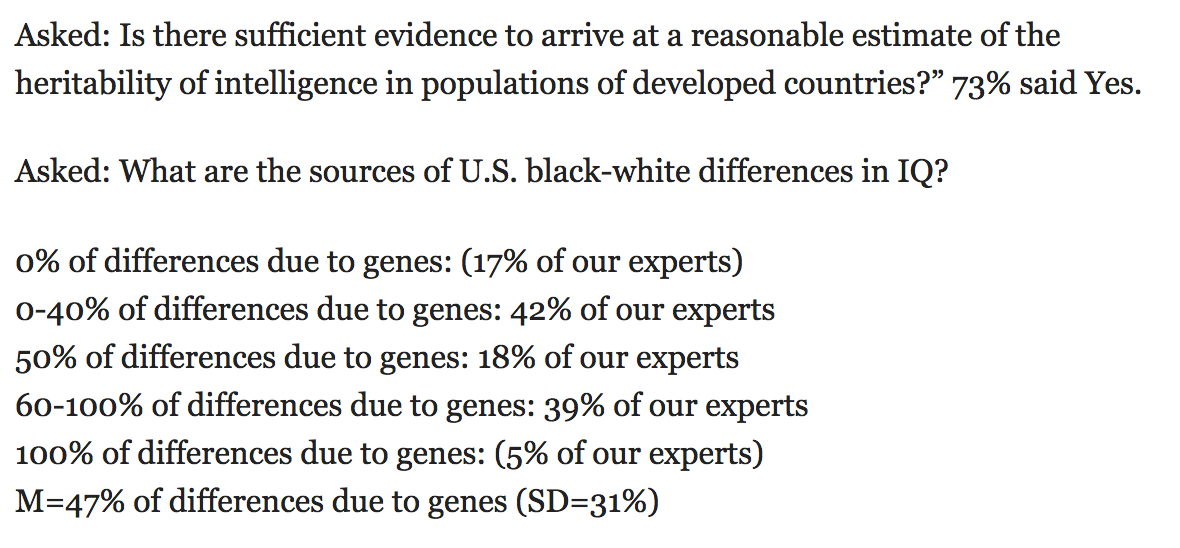
Note that I am not the lone psychometrician in pointing to genetics as the cause of black/white IQ differences. In 2013, a survey of 228 intelligence researchers found that the typical scientist in this field agrees:
Sunday, May 6, 2018
Secret to intelligence? New link between brain cell size and IQ may help scientists find a way to enhance human intellect
For the first time, scientists have discovered that smart people have bigger brain cells than their peers.
As well as being bulkier, the cells are better connected to their neighbours, allowing them to process more information at a faster rate.
If results of the study are confirmed, it could help researchers find a way to enhance our intelligence.
A study, led by Natalia Goriounova at the Free University Amsterdam, gave an IQ test to 35 people who were due to undergo brain surgery, according to report in New Scientist.
During surgery, doctors took a small sample of healthy brain tissue from the temporal lobe of the volunteers. This piece of human brain was then kept alive for testing in a lab.
Dr Goriounova compared the size and shape of the brain cells with volunteers' IQ scores. They found that the brain cells are significantly bigger in people with higher IQs.
Brain cells from smarter people also have more dendrites, which are short extensions of the main neuron that connect to other cells. These tiny projections are important in transferring information from one cell to another.
The study is the first to ever show that the physical size and structure of brain cells is related to a person's intelligence levels.
Christof Koch at the Allen Institute for Brain Science in Seattle told New Scientist: 'We've known there is some link between brain size and intelligence. The team confirm this and take it down to individual neurons.
The concept of intelligence being derived from brain structure could ruffle feathers among some in the academic field.
Dr Koch said: 'Some people will say intelligence is so elusive and complex that the idea it can be tied to individual neurons is implausible.'
The research team also tested people's ability to transmit electrical signals, mimicking the processing of information.
What they found was that people with a low IQ coped at a low frequency, but rapidly became fatigued. The smarter people did not slow down and continued to transmit even at a high rate of stimulation.
'What they did here is extraordinary neuroscience,' says Richard Haier at the University of California, Irvine. 'It's the beginning of being able to study intelligence neuron by neuron, and circuit by circuit.
'This research could lead to neuroscience-based ways to enhance human intelligence – perhaps dramatically. 'We might be able to treat intellectual disabilities or prevent them from occurring.'
'Theoretically, we can say that with both pluripotent and embryonic stem cells that we can create larger brain cells which, when combined with this recent research, would indicate that we could increase intelligence,' Michele Giugliano, co-author and professor at the University of Antwerp told MailOnline.
'This was shown in rodents as we grafted these cells into the brain of mice.
'The problem is that we do not know if the size of the cell is from genetic cause or neurophsycical cues.
It does seem that it would be theoretically possible to restore human brain matter in the next 50 years to restore cognitive deficit. Ethically, I am not sure if that would be allowed.'
SOURCE
Sunday, April 22, 2018
Social class in Australia
To advance economically in Australia, you are often told to get lots of education. And it's true that the higher you go educationally, the better paid you will usually be. But is it actually education at work? The great predictor of educational success is IQ -- so those who go furthest through the educational system will be those with the highest IQ. So it is most probably your IQ that gets you that good job. Education is just an IQ marker that anyone can read.
As a result of that, some thinkers say that the class system is a series of IQ levels. What we see as Upper class and what we see as lower class will be effects of IQ, and not much more. That is why social mobility is so poor. IQ is highly hereditary so if you are born into a poor family you are unlikely to have the IQ assets to rise above your parent's station.
A curious example of class characteristics in fact being IQ characteristics is from the findings about breast feeding. Affluent mothers make quite a point of breast feeding these days. To put your baby on the bottle will get you scorned and seen as uncaring, ignorant and very low class. Yet We read, for instance, that "The mother's IQ was more highly predictive of breastfeeding status than were her race, education, age, poverty status, smoking, the home environment, or the child's birth weight or birth order". So it's all IQ.
So your eventual place on the socio-economic scale will be where your level of IQ places you, with education being a marker, not a cause. And your IQ is essentially unalterable. So rising up socially will only happen if you are one of the unusual people who come from a humble background but are lucky enough to be born with a high IQ. Your IQ will place you in the right social rank for your level of ability.
Toby Young
sets out in more detail the case for society being invisibly ranked by IQ
Social class in Australia is a topic that often goes undiscussed — but if the response to our series on class is anything to go by, some of you are ready to start talking about it.
Some people got in touch to say they believe the archetype of Australia as the lucky country, where opportunity abounds, rings as true as ever.
But others told us the idea that hard work and application are the only barriers to social mobility is laughable.
What was constant is that everyone had an opinion.
The ABC's recent class quiz prompted a number of curious results.
More than a few people were surprised to find their tastes, according to data compiled as part of the detailed Australian Cultural Fields project, aligned them with middle or upper-class woman aged between 40-59.
Taste — whether you'd rather see a pub band than go to opera, for instance — only explains so much of course, and there are many other factors that help explain where we each sit within Australia's complex and confusing class structure.
Sue, a public servant from Darwin, describes herself as a "late baby boomer". She once lived in Sydney, but moved to the Northern Territory with her husband for his job in construction work. "I'm definitely a middle-class person," she said.
"Class in the NT looks much different to what it would in New South Wales. In terms of access to housing, education, employment, health outcomes — it keeps class very much at the forefront of your mind."
Julie wrote in to tell us about her family full of "shop-stewards, miners, railway workers, shipbuilders and plumbers".
"All politically aware, self-educated and proud of their working-class community solidarity," she said.
"My grandfather would say to explain wealth and class: 'Remember no-one is better than anyone else, it is just some people are better off'."
Education opens doors
A running theme through the conversations was the notion of education as being key to class mobility.
Greg, from Melbourne, comes from a working-class background.
"Education was the 'mobility enabler' for me. A beneficiary of Whitlam's education reforms in the 1970s, access to university was merit-based. It opened the door to me," he said.
Brisbane-based policy officer Chris believes his upbringing and education provided him with a platform that's not necessarily attainable for all Australians.
"I have relatively secure professional work and I'm paid reasonably well, I'm aware of my privileged position in the social hierarchy," he said.
"It was impressed on me that I should go to university, that I should improve myself intellectually, financially."
But education isn't always easily accessible.
Alice comes from a modest background and decided to go to university after achieving a UAI of 97.7.
Throughout her time at university, she has struggled to make ends meet, despite working multiple jobs.
"I'm safe for now. But should I choose to embark upon a Master's component, and my benefits are taken away … who knows where I'll end up. As an intelligent woman in her mid-thirties, I shudder to think that my future may very well lie in the streets as a homeless person, making me yet another uncomfortable statistic for everyone else to gawk at."
SOURCE
Sunday, April 8, 2018
It's all in the genes
In their never ending quest to pooh-pooh the genetic influence on IQ (and everything else), a common Leftist suggestion has been that the genetic influence is "moderated" by environmental factors. Socio-economic status has been nominated as such an environmental influence. That has just had a big test and the answer found is that genes rule. Their effect is not moderated by environmental influences. Article below followed by journal Abstract
It's amusing that the authors don't want to believe their own results. They seize on things that might rescue their hypothesis. They say, for instance, that "Among twins and siblings pairs who were close in age, standardized math and reading scores increased proportionally along with mothers' years of education beyond high school"
They attribute that to an environmental influence when it could better be explained by saying that smarter mothers undertake more education. And smarter mother have smarter kids of course.
They really are pathetic in their attempt to hang on to political correctness
Genes and environment have equal influence in learning for rich and poor kids, study finds
More than 40 years ago, psychologist Sandra Scarr put forth a provocative idea: that genetic influence on children's cognitive abilities is linked to their family's income. The wealthier the family, the more influence genes have on brain development, the thinking went.
Scarr turned the nature-nurture debate on its head, proposing that how much "nature" matters varies between environments. Scarr's research has since been roundly debated and thoroughly studied by other researchers with mixed results, including reaffirmation by another American psychologist, David Rowe, in 1999.
The line of research has come to be called the Scarr-Rowe hypothesis—that parents' socio-economic status moderates genetic contributions to variation in intelligence. The thinking was that, for people of lower socio-economic status, a person's intelligence is influenced more by his or her environment than by genetics, meaning whether a child reaches full potential depends on economic standing.
I have been studying the relationship of early health conditions to subsequent school performance for 25 years and been fascinated by the role that genetics and environment play in student achievement.
A group of us set out re-examine the question: Are genetic influences on cognitive abilities larger for children raised in more advantaged environment? To get that answer, I collaborated with colleagues at Northwestern University and Stanford University.
Studying twins, siblings gives insight
We analyzed birth and school records of 24,000 twins and nearly 275,000 siblings born in Florida between 1994 and 2002. As did previous researchers who examined genetic and environmental influences of cognitive development, we focused on a very large set of twins and siblings.
Twins and siblings close in age allowed us to disentangle the role of genes and environment in development of cognitive ability. We found no evidence that social class played more of a role in educational performance for poor kids than for rich ones.
While students in the higher income groups performed better than students in the lower income groups, the relative influence of genetic and environmental differences was the same across groups. The results were published recently in the Proceedings of the National Academy of Sciences.
A complex gene-environment interaction
What is the significance of our findings? According to David Figlio, dean of the School of Education at Social Policy at Northwestern and lead author of the study, we did not confirm that environmental factors mitigate the effects of genetics on cognitive development. Environmental differences are just as important for students from affluent backgrounds as students from poorer backgrounds.
Recent research has found evidence of a difference in genetic influence on academic performance between rich and poor families in the United States, when compared with families in Australia or Western Europe.
However, our research did not replicate the U.S. findings, in part because our large data set from Florida represented a very socio-economically diverse set of families.
Our findings, however, do not contradict the overall pattern that parental socio-economic status is associated with children's cognitive development. Among twins and siblings pairs who were close in age, standardized math and reading scores increased proportionally along with mothers' years of education beyond high school.
SOURCE
Socioeconomic status and genetic influences on cognitive development
David N. Figlio, Jeremy Freese, Krzysztof Karbownik and Jeffrey Roth
Abstract
Accurate understanding of environmental moderation of genetic influences is vital to advancing the science of cognitive development as well as for designing interventions. One widely reported idea is increasing genetic influence on cognition for children raised in higher socioeconomic status (SES) families, including recent proposals that the pattern is a particularly US phenomenon. We used matched birth and school records from Florida siblings and twins born in 1994–2002 to provide the largest, most population-diverse consideration of this hypothesis to date. We found no evidence of SES moderation of genetic influence on test scores, suggesting that articulating gene-environment interactions for cognition is more complex and elusive than previously supposed.
SOURCE
Subscribe to:
Posts (Atom)


 Eugenio Pacelli, a righteous Gentile, a true man of God and a brilliant Pope